
The Strategic Necessity of Randomization #
The act of shuffling randomizes the deck, allowing pure chance to guide the strategic output. Given the larger size and thickness of TCG cards compared to standard playing cards, use a method that ensures full randomization without damaging the cards . This is not merely a mechanical necessity; it is a vital protocol of randomization and resource integration. After stabilizing your mindset and resetting the deck, the shuffleProgramming the Simulation. The rhythmic act of mixing the c More is the final step in establishing a clean field for analysis.
It ensures that the seventy-eight distinct archetypesA recurrent symbol or motif in literature, art, or mythology More of the Major Arcana, Minor Arcana, and Court Cards are thoroughly mixed, providing a true reflection of the hidden variables currently active in your life’s strategy. You must perform this action with mindfulness, focusing on the intention you set, allowing the cards to move from a state of controlled order to one of purposeful chaos.
Approved Shuffling Techniques #
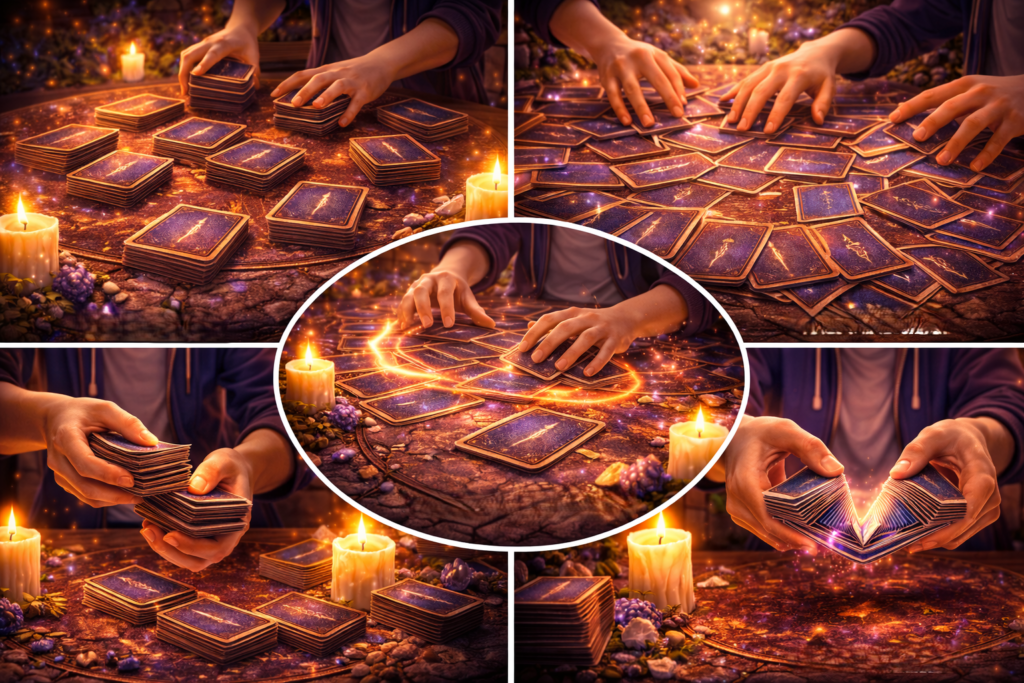
The Pile Shuffle #
Divide the deck into 7 to 10 piles and re-stack them in a random order. Repeat this process three times to ensure that clumps of suited cards are broken apart.
The Wash Shuffle #
SpreadThe Battle Formation. A specific geometric arrangement of ca More the cards face down across a flat surface and mix them vigorously for at least 30 seconds before re-gathering them into a single stack. This mimics the chaos of a wild encounter before the battle begins. the reading reciever can assist in this shuffle.
The Traditional Overhand #
Shuffle This method is the most basic and intuitive, favored for its tactile connection and simplicity. To perform the overhand shuffle, hold the deck in your dominant hand and, with the non-dominant hand, peel off small packets of cards from the top, allowing them to drop into the dominant hand, stacking them haphazardly. This technique is excellent for dispersing large chunks of similar cards and maintaining a physical, grounding connection with the deck. It is a slow, steady process, the disciplined method of a veteran Trainer who respects the weight of their tools.
The Riffle Shuffle #
For those who have taken the optional step of sleeving their cards, the riffle shuffle is the most effective way to ensure deep, thorough randomization. This is the precision maneuver of a competitive player. Divide the deck into two equal halves, holding one in each hand. Place the inner corners of the two halves against one another, and allow the cards to gently weave together, forming a single, fused deck. This method completely interlaces the various suits and archetypesA recurrent symbol or motif in literature, art, or mythology More, providing the highest degree of randomness. It should only be attempted if your cards are protected by high-quality sleeves, as exposed cardboard can easily be damaged by the friction of the riffle.
Spreading and Swirling (The Map Unfurled) #
A less conventional but profoundly effective clearing and mixing technique is to treat the reading surface as a vast Strategic Map. After a preliminary shuffle, spreadThe Battle Formation. A specific geometric arrangement of ca More the entire deck face down across your dedicated reading cloth. Use both hands to slowly and deliberately swirl the cards around, moving them in sweeping, figure-eight motions, allowing every card to touch every other card. This physical interaction breaks down any lingering numerical or sequential patterns, refreshing the deck’s potential like a fresh save file. When you feel the randomization has reached its peak, slowly and mindfully begin to gather the cards back into a single, cohesive stack, sensing the seventy-eight archetypesA recurrent symbol or motif in literature, art, or mythology More unifying into a single, potent whole.
The Final Cut #
The shuffleProgramming the Simulation. The rhythmic act of mixing the c More is followed by the CutThe Final Validation. Splitting the deck after shuffling. It More, which transfers the final, personal authority of the draw from the chaotic nature of RNG back to the Trainer’s calculated control. Once the deck is thoroughly shuffled and squared, place it on the table. Use your non-dominant hand to lift a large portion of the deck from the top and place it next to the bottom portion. Then, lift the remaining cards and place them on top of the original bottom portion, reassembling the deck into a single stack. This final, intentional motion marks the official end of the randomization phase. The cutThe Final Validation. Splitting the deck after shuffling. It More places the perfect, randomized card at the exact top position, ready to be drawn, symbolizing your readiness to engage the opening hand dealt to you. The deck is now quiescentIn a state or period of inactivity or dormancy. The state of More, awaiting the draw that will reveal the current strategic alignments of your journey.