
The Major Arcana is not merely a random collection of powerful cards; it is a linear map of evolutionThe concept that the Major Arcana is not random, but a seque More. In Tarot scholarship, these twenty-two cards are traditionally divided into “The Fool” (0) and three distinct rows of seven cards, known as the Septenaries. This architecture maps perfectly onto the Pokémon journey—from the moment you leave your hometown, to the mid-game challenges of evolution and character growth, to the final, cosmic battles of the Pokémon League.
Understanding which “Stage” a Major Arcana card belongs to allows the Strategist to instantly identify the scope of the problem at hand.
The Protagonist (Card 0) #
The Fool stands outside the numbered sequence because he is the one taking the journey. He is the Trainer stepping out of Pallet Town for the first time, holding a starter Pokémon and an empty Pokédex. He has no experience (0), but he possesses infinite potential. When this card appears, it signifies a new save file—a fresh start where no mistakes have yet been made.
Stage 1: The Conscious World (Cards I – VII) #
- Range: The Magician (I) through The Chariot (VII).
- Theme: The Material World & Identity.
- Pokémon Analogy: The Early Game (Badges 1-3).
This is the stage of “Setting the Scene.” These cards represent the external forces of society, education, and authority. Here, the Trainer learns the rules of the world. You meet your Professors (The Magician), learn the lore (The High Priestess), encounter authority figures (The Emperor / The Hierophant), and make your first defining choices about who you want to be (The Lovers).
When cards from this stage appear, the issue is usually external and practical: Are you prepared? do you have the right tools? Do you respect the rules of the Gym? It culminates in The Chariot, the moment the Trainer leaves home with a hardened resolve and a specific goal in mind.
Stage 2: The Subconscious Journey (Cards VIII – XIV) #
- Range: Strength (VIII) through Temperance (XIV).
- Theme: Internal Growth & Challenge.
- Pokémon Analogy: The Mid-Game Grind (Evolution & Plot Twists).
The journey now turns inward. The Trainer has left the safety of civilization and entered the darker caves and taller grass. This stage is about Character Evolution. You are no longer just collecting Badges; you are facing your own limitations.
You must learn to control your impulses (Strength), face the solitude of the long road (The Hermit), and accept that luck is a mechanic you cannot control (Wheel of Fortune). This stage forces you to make sacrifices (The Hanged Man) and accept inevitable endings (Death). It is the messy, difficult middle chapter where your Starter Pokémon evolves into its second stage—stronger, but stripped of its cuteness. These cards ask you to question why you are fighting.
Stage 3: The Superconscious (Cards XV – XXI) #
- Range: The Devil (XV) through The World (XXI).
- Theme: Cosmic Forces & Destiny.
- Pokémon Analogy: The Elite Four & The Box Legendary.
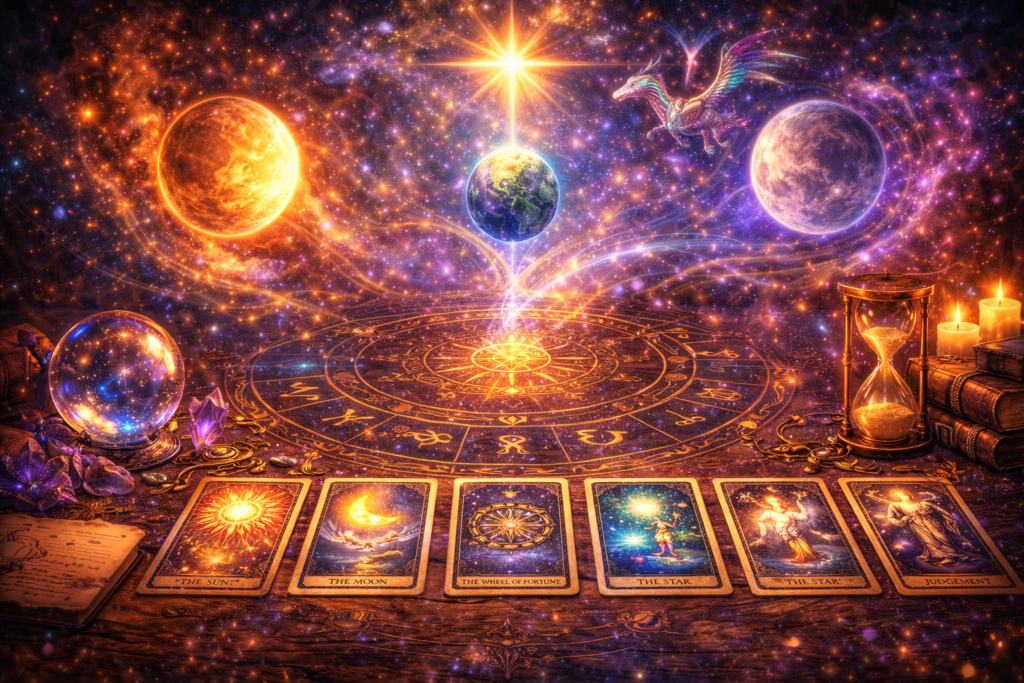
We have now reached the End Game. The concerns here are no longer about “winning a match” or “feeling sad”; they are about Universal Truths. These cards represent forces that are largely out of the Trainer’s control. You face the shadow self (The Devil), the sudden cataclysm of the villain’s plot (The Tower), and the cosmic hope that follows disaster (The Star).
This path leads through the illusions of Victory Road (The Moon) to the clarity of the Champion’s Hall (The Sun), finally arriving at the ultimate judgment of your worth (Judgment). The journey ends with The World (Mew)—the completion of the Pokédex, the Hall of Fame, and the realization of total unity. When these cards appear, destiny is in the driver’s seat.