
The Philosophy Behind the Pairings #
To assemble a deck that truly speaks the language of both Lore and Strategy, we began with a single, uncompromising principle: The connection between the Tarot archetypeA recurrent symbol or motif in literature, art, or mythology More and the Pokémon card must be absolute. We did not choose pairings based on what looked colorful or what simply felt nostalgic; we demanded
Authenticity
over
Aesthetic.
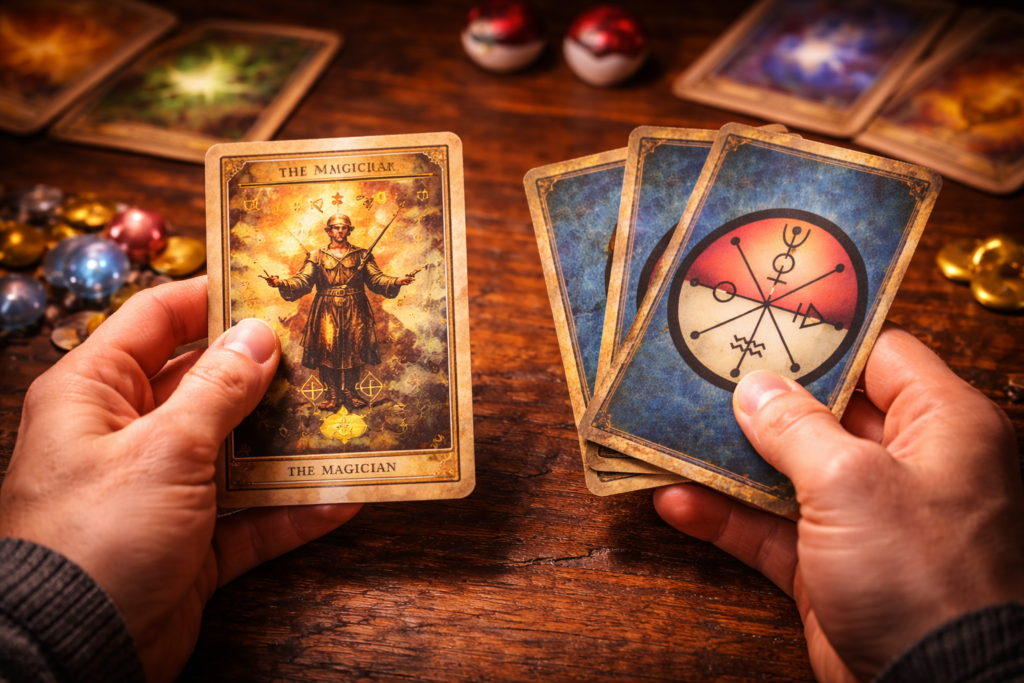
The power of this deck is unlocked only when a Pokémon’s essential nature its Pokédex entry, its abilities, and its narrative journey perfectly mirrors the specific function of the Tarot card. For us, the connection was not invented; it was decoded through a careful study of the source material.
The Pairing Logic: Lore as Law #
Major Arcana: The Legends #
Consider the Major Arcana first. These are the twenty-two legends, the mythical forces that anchor the human experience. Their stories must carry the biggest, most universal weight. For a Pokémon to claim one of these seats, its entire existence must be an echo of that archetypeA recurrent symbol or motif in literature, art, or mythology More.
Mewtwo, a creature of genius and solitude, engineered in a laboratory and forever searching for purpose, is not just like The Hermit; he is The Hermit, embodying deep isolation and a desperate need to find meaning in a world he never asked to join. His struggle is the card’s struggle. Likewise, consider the sudden, furious evolution of Magikarp into the devastating Gyarados. This is the ultimate, unforgettable illustration of unavoidable crisis. All that stored potential, all that suppressed pressure, explodes into a catastrophic, necessary transformation. That dramatic, total upheaval is the essence of The Tower. When a Major Arcana appears, you are facing a moment of destiny that mirrors the power and profound complexity of these legends.
Minor Arcana: The Mechanics #
The Minor Arcana the seventy-eight cards of daily life tell a different story. They focus not on legends, but on the actions of the Trainer. These cards are largely Trainer and Energy cards because they represent the resources, the decisions, and the immediate, tactical moves that govern your daily battles.
Case Study: The Hand Reset Take, for instance, a card like Professor Oak that forces you to discard your entire hand and draw seven new cards. In the heat of the moment, this feels like a crisis a painful act of resource sacrifice. Yet, it forces a complete, sudden renewal of your options, giving you a statistical probability for a better set of moves. This is not about bad luck; it is about the tactical necessity of a Hard Reset leading to a new Win Condition The question is always:
What effect does
this card
have on the battle?
Take, for instance, a card that forces you to discard your entire hand and draw seven new cards. In the heat of the moment, this is a crisis a painful act of sacrifice and loss. Yet, it also forces a complete, sudden renewal of your resources, giving you a chance for a far better set of moves. This is not about bad luck; it is about the spiritual necessity of total loss leading to necessary rebirth the profound hardship that defines the difficult Five cards in any suitThe Energy Class. One of the four divisions of the Minor Arc More.
The cards are designed to challenge you to think like a Champion: to see your life’s challenges not as coincidence, but as a series of tactical decisions where the underlying truth is revealed through the card’s function.
The Origins of the System #
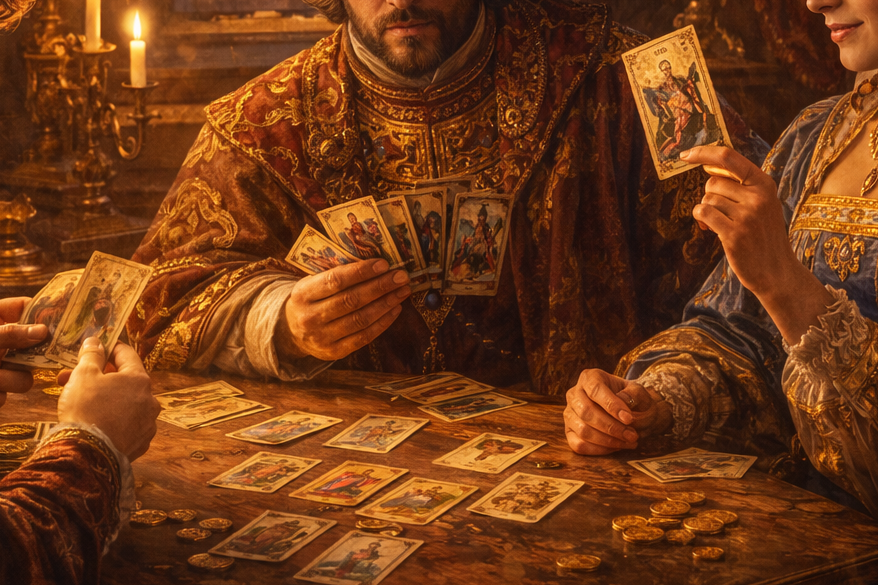
Understanding the ArcaneDex requires understanding the versions that came before it. We view the history of Tarot not as a dusty lineage, but as a series of system updates.
Version 1.0: Tarocchi (The Strategy Game) #
Long before Trainers battled for badges, the nobility of 15th-century Italy engaged in a strategic duel known as Tarocchi. Much like the early days of the Pokémon TCG, these decks were originally designed for recreation—elaborate, hand-painted playing cards used by the aristocracy of Milan and Florence. The earliest decks, such as the Visconti-Sforza, were masterpieces of art. It was a game of trick-taking, a test of memory and strategy rather than a mirror of the soul.
Version 2.0: The “Mystic” Mod
Just as a Pokémon evolves under specific conditions, the purpose of the Tarot underwent a profound metamorphosis in the late 18th century. Scholars and mystics, such as Antoine Court de Gébelin, began to perceive a deeper, hidden code within the imagery a “MacroverseA large-scale structure or system containing smaller systems More” of ancient data concealed within the cards. They theorized that these images were not merely for play, but were remnants of forgotten knowledge. The deck ceased to be a simple pastime and became a tool for analysis. The cards became windows into the subconscious, capable of scanning the Gamestate of the user much like a Pokédex scans for data.
Version 3.0: The Modern StandardThe "Rider-Waite-Smith" (1909). The current stable build. Wa More (Rider-Waite-Smith)
The system we use today was codified in 1909 by Arthur Edward Waite and the artist Pamela Colman Smith. They revolutionized the deck by illustrating all seventy-eight cards (including the Minor Arcana) with rich, narrative scenes rather than simple pips. This “Rider-Waite-Smith” deck established the visual language of modern Tarot, grounding abstract concepts in relatable human stories.
The ArcaneDex adapts this foundational structure, translating those universal human archetypesA recurrent symbol or motif in literature, art, or mythology More into the vibrant, elemental lore of the Pokémon world to create a tool perfectly tuned for the modern Strategist.